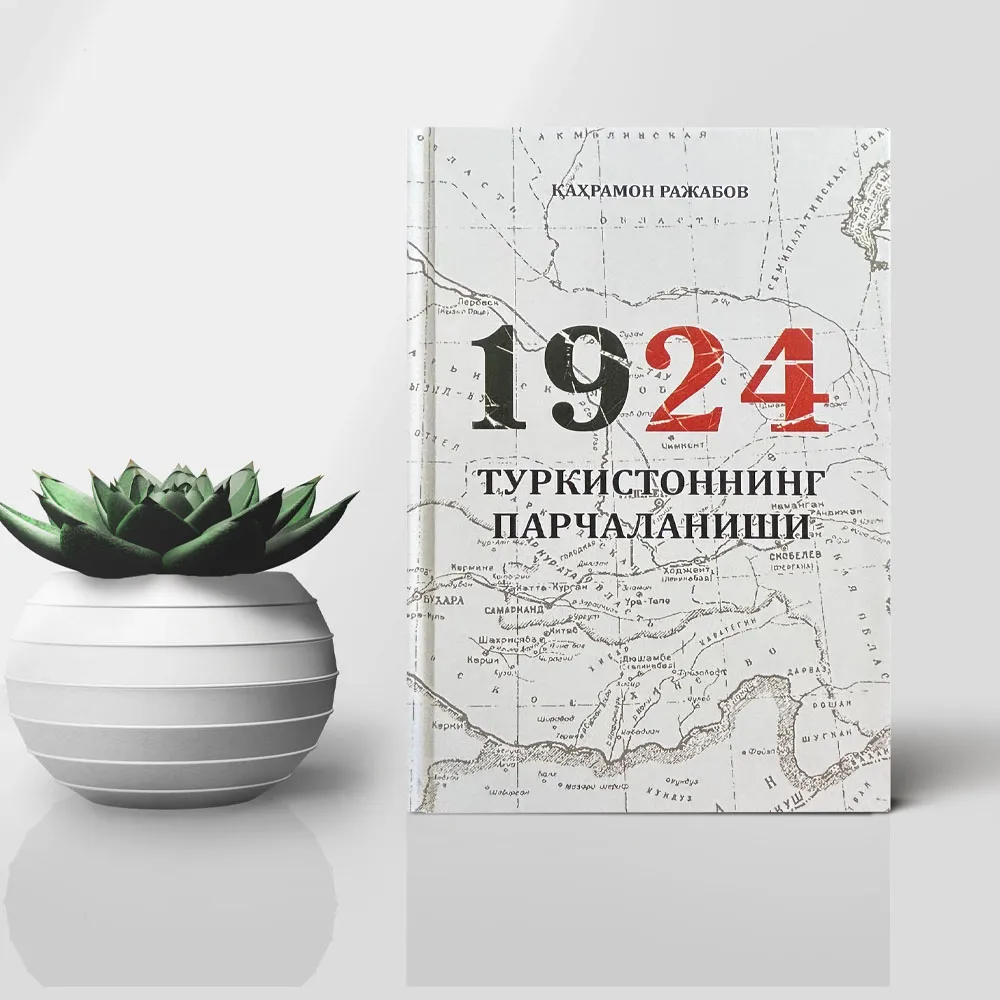
The Dismantling of Turkestan 1924: The Hidden Truths of National-Territorial Delimitation
97000 so'm
The monograph “The Dismantling of Turkestan 1924!” provides an impartial and honest analysis of one of the most complex and contentious periods in Central Asian history: the national-territorial delimitation policy implemented in the autumn of 1924. This foundational work allows you to gain a profound understanding of the events that fundamentally altered the region’s geopolitical map, uncovering their true causes and consequences. ✅ **Why should you read this book?** This book is more than a mere collection of dates and names; it is a unique study that reveals how communist ideology, under the guise of “national statehood,” dismantled the peoples of Turkestan and fractured their unity. The author, historian Qahramon Rajabov, presents unparalleled evidence based on years of archival research—including “top secret” data held in the Republic of Uzbekistan and the Russian Federation—as well as a comparative analysis of contemporary press materials and existing historical literature. 🔹 **Key Value and Advantages of the Work:** * **Uncovering Hidden Truths:** The book presents facts hidden from our people during the era of the Red Empire, clarifying the deceit and sinister plans of the Bolsheviks. The primary goal of this policy was to consolidate central authority in the region and prevent the various peoples from uniting to form a strong, independent state. * **Objective and Honest Analysis:** Adhering strictly to scientific principles, the monograph is written based on archival materials and other reliable sources. This enhances its academic value and provides the reader with a transparent view of the events. * **The Formation of the Uzbek SSR and the Region:** The book details how the Uzbek SSR, along with other allied and autonomous republics and regions, was formed in 1924 from the territories of the Turkestan Autonomous Soviet Socialist Republic (TASSR), the Bukharan People’s Soviet Republic (BPSR), and the Khorezm People’s Soviet Republic (KPSR). These structures were, in reality, far from independent states and served merely as components of a single Soviet state. * **The Author’s Distinctive Style:** Qahramon Rajabov’s style goes beyond the dry recitation of facts. By applying a deep scientific approach to analyzing events, he keeps the reader’s interest engaged throughout. His work serves as a crucial resource for the modern history of Uzbekistan. 📚 **Who is this book for?** This monograph is intended for all readers who care about the history of Turkestan. It serves as a valuable resource for historians, political scientists, students, researchers, and the general public interested in the history of national identity and statehood. The book provides new insights into national liberation movements and their aftermath. 🌐 **Significance for Today:** The 1924 delimitation helps us understand its importance not only in the past but also in contemporary Central Asian geopolitics. Its influence on the region’s ethnic, social, and economic factors, the process of national state-building, and its long-term consequences—including territorial disputes and inter-ethnic relations—remain highly relevant today. This work is an invaluable guide to understanding the history, future, and regional position of the Uzbek people. It provides the necessary knowledge and analytical skills to learn from the past and build a more stable future. Recommended for publication by the Scientific Council of the Institute of History of the Academy of Sciences of Uzbekistan (based on the protocol of the extraordinary meeting dated October 27, 2024), this book is built on solid academic foundations. **Conclusion:** The dismantling of Turkestan is not just a dark chapter; it is an inseparable part of our people’s long and arduous journey toward independence. Through this monograph, you are encouraged to view the past with fresh eyes, draw objective conclusions, and cherish the value of today’s independence. For anyone seeking a deep understanding of Uzbekistan’s history, this book is absolutely essential.
Place an Order
Frequently Asked Questions (FAQ)
- What was the national-territorial delimitation policy of 1924?
- The national-territorial delimitation policy of 1924 was a political measure implemented by the Soviet regime under the guise of establishing "national states" in Turkestan. In reality, it aimed to fracture the peoples of the region and consolidate the dominance of the Center. As a result of this policy, the territories of the Turkestan ASSR, Bukharan PSR, and Khorezm PSR were divided to create the Uzbek SSR, the Turkmen SSR, and other republics.
- Who is the author of the book "The Dismantling of Turkestan 1924!"?
- The author of the monograph "The Dismantling of Turkestan 1924!" is historian Qahramon Rajabov.
- What sources is the book based on?
- The monograph is written based on a comparative analysis of archival documents held in the Republic of Uzbekistan and the Russian Federation, "top secret" data from closed archives, materials from the press of that era, and historical literature published both in Uzbekistan and abroad.
- When was the Uzbek SSR formed?
- The Uzbek SSR was formed on October 27, 1924. It was announced that the newly formed Uzbek SSR would include the regions of Tashkent, Samarkand, Fergana, Kashkadarya, Zarafshan (Bukhara), Surkhandarya, Khorezm, and the Tajik ASSR.
Customer Reviews
0 reviews- No reviews yet. Be the first to leave one!